Cameron Carpenter

Cameron Carpenter

November 2020
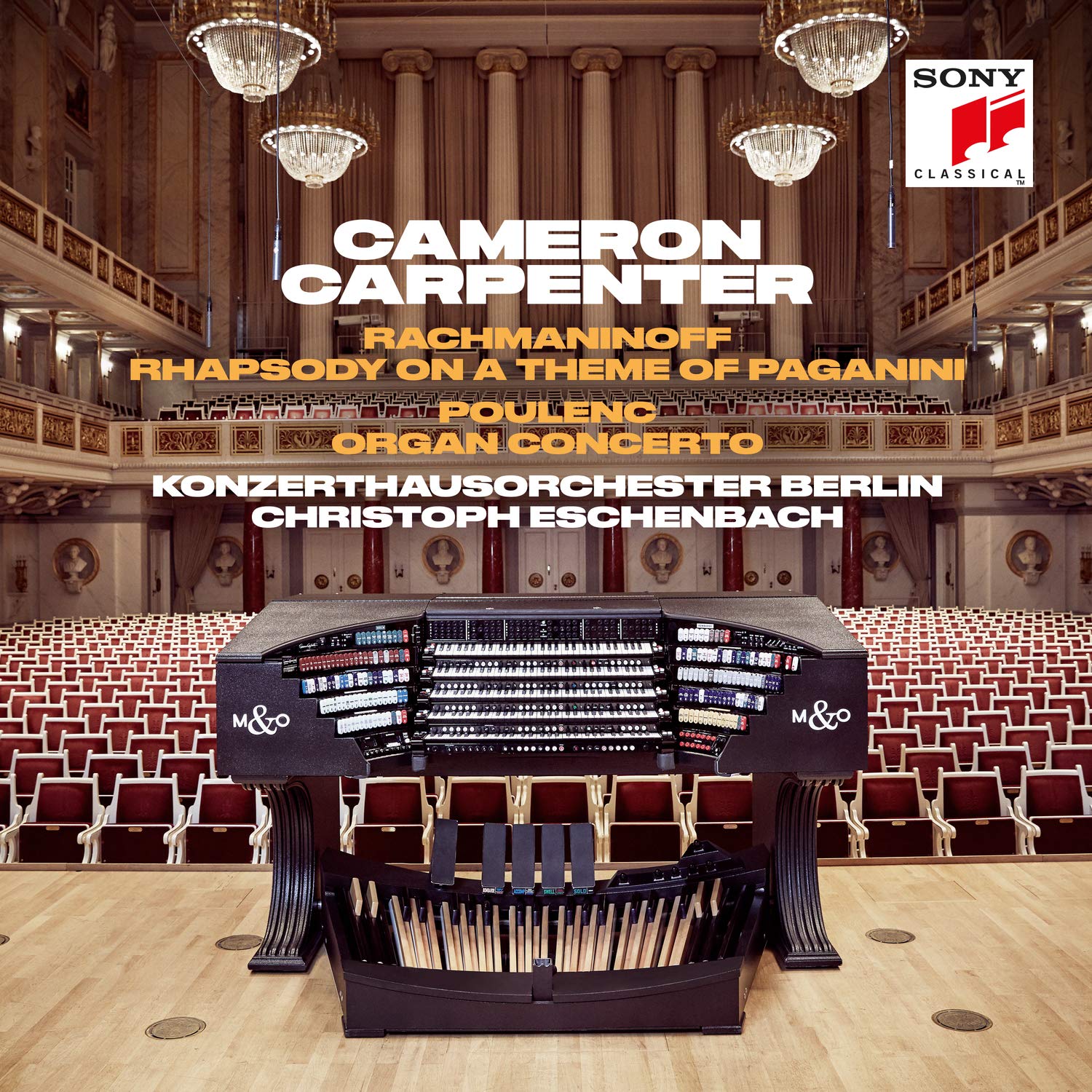
This album released by Sony Classical was the American organist Cameron Carpenter first orchestral recording, and also his first live concert recording. This release features an original Rhapsody version of a song by Rachmaninoff’s Paganini, recorded live at Berlin’s Konzerthaus, alongside Poulenc’s Popular Concerto for Organ, Strings and Timpani. The album program is completed by Vierne’s Organ Symphony No. 1, recorded live as the encore for the concert. Carpenter is accompanied by the Konzerthausorchester Berlin under the direction of renowned director Christoph Eschenbach.  

The artist’s adaptation for organ and orchestra of the Rhapsody on a theme by Rachmaninov’s Paganini demonstrates Carpenter’s exemplary musical ability.  This is not an easy task indeed, because of the complexity involved in combining the orchestra with a solo instrument of equal or superior possibilities. However, Carpenter’s version is perfectly balanced, with no relevant interferences and just right to meet his personality and his manual and pedal technique. The Rachmaninov’s piece keeps the original essence but with a new fresh spirit. Carpenter performs with great control and artistry, and at the same time he takes our breath away leading us to feel the unbridled romanticism of the work. 

Poulenc’s concerti is considered one of the most popular of organ concerti and affecter this recording it definitely became even more well known. Carpenter, now as a rigorous soloist, masters it amazing us once again with his incredible technique.  

Maybe the weakest point of the recording is The Vierne where we can spot an over elongation of the musical line and the frequent change in tonal registrations and the tempi which doesn’t seem to match with the original work. 

The orchestra accompaniments under the artistic and creative direction of Mr. Christoph Eschenbach become a crucial part of the performance. They sound precise and clear and in complete synchronization with the organist.  

We must also point out the superb recording quality of the CD which totally gives protagonism to the organ in this tonal combination of organ and orchestra. The sound jumps out of the digital world into your space with power and motion. 
The 14 pages booklet also contain the detailed explanations of this fine M&O Touring Organ and is the first time that they have been published. We definitely recommend you to use a good stereo System to enjoy this Jewel CD to the fullest!

– Clara Horner

Rachmaninoff. Rhapsody on a theme of Paganini
Cameron Carpenter
Sergei Rachmaninoff
1. Rhapsody on a Theme of Paganini, Op.43: Introduction: Allegro vivace – Variation I: Precedente
2. Rhapsody on a Theme of Paganini, Op.43: Theme: L’istesso tempo
3. Rhapsody on a Theme of Paganini, Op.43: Variation 2: L’istesso tempo
4. Rhapsody on a Theme of Paganini, Op.43: Variation 3: L’istesso tempo
5. Rhapsody on a Theme of Paganini, Op.43: Variation 4: Più vivo
6. Rhapsody on a Theme of Paganini, Op.43: Variation 5: Tempo precedente
7. Rhapsody on a Theme of Paganini, Op.43: Variation 6: L’istesso tempo
8. Rhapsody on a Theme of Paganini, Op.43: Variation 7: Meno mosso, a tempo moderato
9. Rhapsody on a Theme of Paganini, Op.43: Variation 8: Tempo I
10. Rhapsody on a Theme of Paganini, Op.43: Variation 9: L’istesso tempo
11. Rhapsody on a Theme of Paganini, Op.43: Variation 10: L’istesso tempo
12. Rhapsody on a Theme of Paganini, Op.43: Variation 11: Moderato
13. Rhapsody on a Theme of Paganini, Op.43: Variation 12: Tempo di minuetto
14. Rhapsody on a Theme of Paganini, Op.43: Variation 13: Allegro
15. Rhapsody on a Theme of Paganini, Op.43: Variation 14: L’istesso tempo
16. Rhapsody on a Theme of Paganini, Op.43: Variation 15: Più vivo scherzando
17. Rhapsody on a Theme of Paganini, Op.43: Variation 16: Allegretto
18. Rhapsody on a Theme of Paganini, Op.43: Variation 17: Allegretto
19. Rhapsody on a Theme of Paganini, Op.43: Variation 18: Andante cantabile
20. Rhapsody on a Theme of Paganini, Op.43: Variation 19: A tempo vivace
21. Rhapsody on a Theme of Paganini, Op.43: Variation 20: Un poco più vivo
22. Rhapsody on a Theme of Paganini, Op.43: Variation 21: Un poco più vivo
23. Rhapsody on a Theme of Paganini, Op.43: Variation 22: Marziale: Un poco più vivo Alla breve
24. Rhapsody on a Theme of Paganini, Op.43: Variation 23: L’istesso tempo
25. Rhapsody on a Theme of Paganini, Op.43: Variation 24: A tempo un poco meno mosso
26. Rhapsody on a Theme of Paganini, Op.43: Più vivo
Francis Poulenc
27. Concerto for organ, timpani and strings in G minor FP 93: I. Andante
28. Concerto for organ, timpani and strings in G minor FP 93: II. Allegro giocoso
29. Concerto for organ, timpani and strings in G minor FP 93: III. Subito Andante Moderato
30. Concerto for organ, timpani and strings in G minor FP 93: IV. Tempo Allegro. Molto Agitato
31. Concerto for organ, timpani and strings in G minor FP 93: V. Très calme. Lent
32. Concerto for organ, timpani and strings in G minor FP 93: VI. Tempo de l Allegro initial
33. Concerto for organ, timpani and strings in G minor FP 93: VII. Tempo Introduction – Largo
Louis Vierne
34. Organ Symphony No. 1 in D minor, Op. 14: VI. Finale

Chopin – Piano Concertos

Chopin – Piano Concertos

November 2020
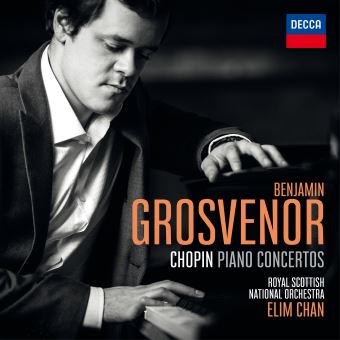
The CD was recorded by the young virtuoso, Benjamin Grosvenor, with the help of conductor Elim Chan at the lead of the Royal Scottish National Orchestra. As the notice states, “one could summarize Benjamin Grosvenor’s rapid rise to the top in a litany of superlatives.” 

The poetic rhyme and spontaneity are repeatedly found throughout these two scores, very well brought to life by Grosvenor. His admirable technique with the right tone and intensity is just mesmerizing. 

The movements succeed in a colorful lyricism as well as eloquent virtuosism. The orchestra glows in sparkling lights, providing a gentle and rhythmic background to the soloist, in which Grosvenor pours all his virtuosity leading us though Chopin’s magnificent music, at once melancholy, fanciful and vigorous. The artists great sensitivity and deep charm is fully revealed in Opus 11, where he gives the Larghetto a refined dreamlike setting in which the listener will feel deeply immersed. The other two movements are confidently performed letting us enjoy the artist’s gifted abilities but without overload or mannerism.  

Grosvenor shines in Opus 21 eagerly delving into lines that seem improvised, with enthusiasm, dynamism and explicit chromatism.  He delights us with a vehement sound that fluidly goes through a song of pearly in a flawless execution, at the top of the pianistic gesture.  

Of the two Concertos, it is above all n° 1 that blows us away from the beginning to the end. His first movement Allegro maestoso admirably articulated, is performed with great passion and lyricism. Benjamin Grosvenor leads us in this intimate Chopinian immersion, all the way to the ultimate achievement of the author: the Andante spianato and Grande Polonaise brillante opus 22 (1836). The work is deeply charged with the nostalgic feeling that Chopin wanted to transmit, and Grosvenor’s interpretation makes it palpable to us. The incredible romantic maturity in which the artists perform the E minor is full of passion that flows through all the piece and goes straight to the listeners’ hearts. 

At the lead of the Scottish National, Elim Chan confirms his talent of attentive support, even if certain accents sometimes ring a little too rough. Nevertheless, this recording made in Glasgow places Grosvenor / Chan among the best modern versions of Chopin’s concertos.

– David Gutman

BENJAMIN GROSVENOR
CHOPIN PIANO CONCERTOS

Richard Strauss Cello Sonatas

Richard Strauss Cello Sonatas

Resonance Rediscovered: Richard Strauss Cello Sonatas

March 2020
When a musical treasure trove is unearthed, it is a cause for celebration among classical enthusiasts. Such is the case with Raphaela Gromes and Julian Riem’s captivating album, featuring Richard Strauss’ Cello Sonatas. The centerpiece of this recording is the Cello Sonata in F Major Op. 6, a work that has held a special place in the hearts of cellists and music aficionados for years. However, what makes this release truly exceptional is the inclusion of the world premiere recording of the previously unknown, original first version of the sonata, composed in 1881.

Gromes and Riem’s relationship with Strauss’ Cello Sonata Op. 6 dates back to 2012 when they incorporated it into their concert repertoire. Learning of the existence of an earlier, radically different iteration of the piece sparked their curiosity, and their dedication to bringing this musical relic to life is evident in their performances.

The album immerses listeners in a fascinating juxtaposition of two versions of the same work. The side-by-side presentation of the original 1881 version and the more familiar 1883 revision allows listeners to trace the evolution of Strauss’ creative process. This approach offers a unique opportunity to appreciate the composer’s artistic growth and the transformative impact of his revisions. Gromes and Riem guide us through these musical time capsules with an expert touch, ensuring that the nuances and contrasts between the versions are vividly brought to life.

The true revelation of this album is the early version of the Cello Sonata, bursting with youthful exuberance and innovation. Gromes’ cello sings with a radiant tone, beautifully complemented by Riem’s sensitive and dynamic piano accompaniment. The artists breathe life into every phrase, infusing the music with a sense of freshness and spontaneity that is truly captivating. The Cello Sonata’s charm is further enhanced by the eloquent dialogue between the cello and piano, demonstrating the profound musical connection between Gromes and Riem.

Beyond the sonatas, the album also treats us to beguiling song arrangements that showcase the depth and versatility of Strauss’ compositional voice. The performances are exquisitely detailed, capturing the subtleties of the music and reflecting the artists’ genuine love for the material.

Raphaela Gromes and Julian Riem’s exploration of Richard Strauss’ Cello Sonatas is a musical journey of discovery and rediscovery. Their commitment to sharing the lesser-known version of the Op. 6 Cello Sonata is commendable, and their performances shed light on a side of Strauss that has long remained hidden. As we are presented with a delightful blend of the familiar and the newly unveiled, this album stands as a testament to the enduring power of music and the art of interpretation. “Recommended” does not begin to capture the depth of this recording; it is a must-listen for anyone seeking a fresh perspective on Strauss’ legacy.